


Practical case · Oversight and remote driving
Who supervises the other nine vehicles?
A fictional case based on promulgated Act No. 248/2026 Coll., effective from 1 December 2026, with reference to draft implementing decree LP/2026/500. The draft decree is not a regulation in force.
1. One person, ten vehicles
A control-centre worker monitors ten fully automated road vehicles. Their automated driving systems (ADS) perform the driving. She monitors operations and alerts and is not currently driving any vehicle.
For this case, assume the conditions for operation and oversight are met. Ten vehicles is the case’s hypothetical configuration. Section 3(2) of draft decree LP/2026/500 also proposes a maximum of ten vehicles monitored simultaneously in fully automated mode. This limit is not yet in force. These are road vehicles, not small pavement robots.
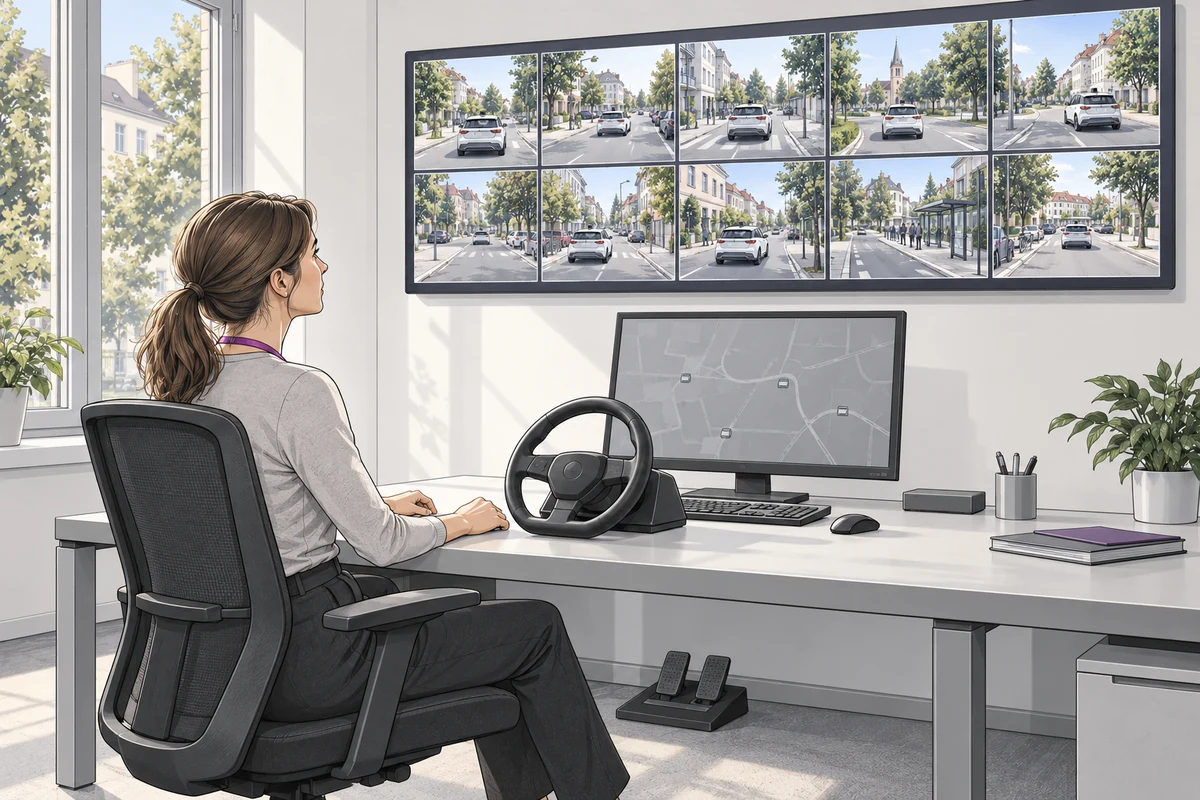
What is the human doing at this point, and what is the ADS doing?
You can simply think through your answer. Notes are not sent anywhere or saved by this page. Copy them before closing it.
Reveal the change in role
2. The human drives one vehicle
Vehicle 7 stops safely before roadworks. There is no immediate danger. The worker takes over remote driving and starts passing the obstacle. Using the camera feed, she continuously controls steering, acceleration and braking. During the manoeuvre, she drives the vehicle and the ADS does not perform the driving.
How does her activity differ from the original oversight? When did her role change?
Reveal a new fact
3. Another vehicle needs attention
During the manoeuvre, an alert arrives from vehicle 3. All nine other vehicles remain assigned to the same worker. Nobody else has taken over their oversight. Their camera feeds remain visible on the side monitor.
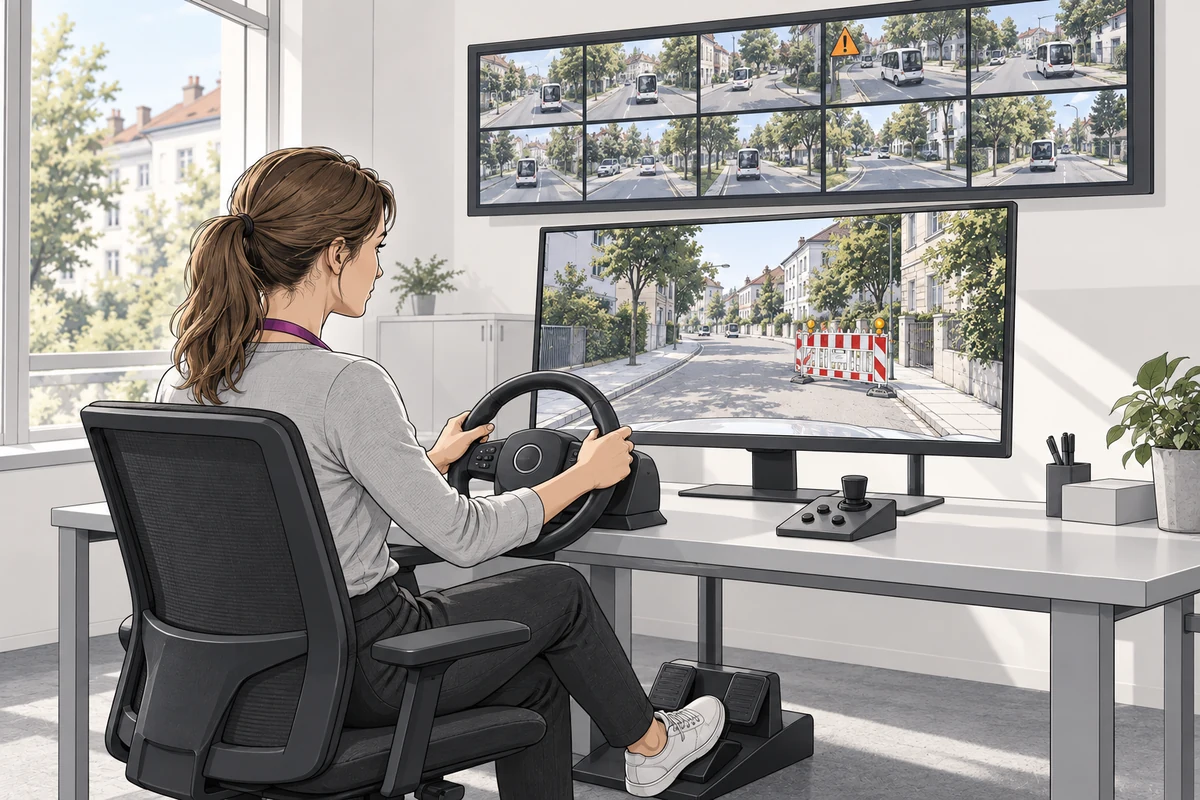
- May she supervise the other vehicles while driving one remotely?
- Propose a process that secures oversight of the other vehicles. Who takes over, and how is the handover verified?
- What if another operator has no spare capacity?
Compare with the analysis
From distinguishing roles to a workable process
The activity performed matters
In the first stage, the worker performs oversight. In the second, she drives the vehicle remotely, so we apply the rule governing a driving takeover. The described actions matter, rather than her job title or the presence of a steering wheel. An alert appearing or a command being confirmed does not, by itself, establish that driving has been taken over.
Why extra screens are not enough
In the case, nobody has taken over oversight. Nine feeds on a screen do not resolve that organisational gap. A workable solution identifies an available person, their capacity and the moment they assume oversight of the vehicles.
One possible process for this case
The following is a proposal for organisational and technical measures. The specific confirmations and software settings are our proposed implementation, not express requirements of the amendment.
Check the takeover conditions
Vehicle 7 is safely stationary in this case. Before the planned manoeuvre, check that remote driving is available and that oversight of the other vehicles is secured.
Hand over oversight and confirm acceptance
Another authorised oversight operator checks their capacity and explicitly accepts the specified vehicles. The system shows which vehicles they supervise. Sending a request alone is not enough.
Separate the driving of one vehicle
The worker drives vehicle 7. The interface clearly identifies this mode and does not simultaneously assign her oversight of other vehicles. A record allows each role and handover time to be checked.
Verify the return to oversight
After the manoeuvre, verify that the ADS has actually resumed driving, then reassign oversight according to available capacity. Letting go of the steering wheel alone does not confirm that transition.
How to check whether the proposal works
In a test, introduce two simultaneous requests, an unavailable replacement operator and an unconfirmed handover. Check who is responsible for the vehicles, whether the interface displays the correct mode and whether the record matches what actually happened.
Takeaway: a change in one person’s activity may require oversight of the entire fleet to be reorganised.
Final reflection
Is it enough to have a person in the control centre, or must we know what they are doing and which vehicles they oversee? Which step in your proposal ensures this?