Select a country and term. Each role identifies its tasks, legal status and specific source.
Cielená kontrola prameňov 2026-09-07 · 19 vybraných rolí.
Similar names do not imply identical legal status. Original terms accompany the explanation. For British roles, the adopted statutory framework is distinguished from the permit regime already in operation.
Compare supervision and driving
The first comparison covers three Slovak and German roles. It shows the difference between taking control, authorising a manoeuvre and directly driving remotely.
Reviewed: 2026-09-07. Comparing functions does not establish legal equivalence between roles.
Supervision and direct vehicle driving — conditions for each role
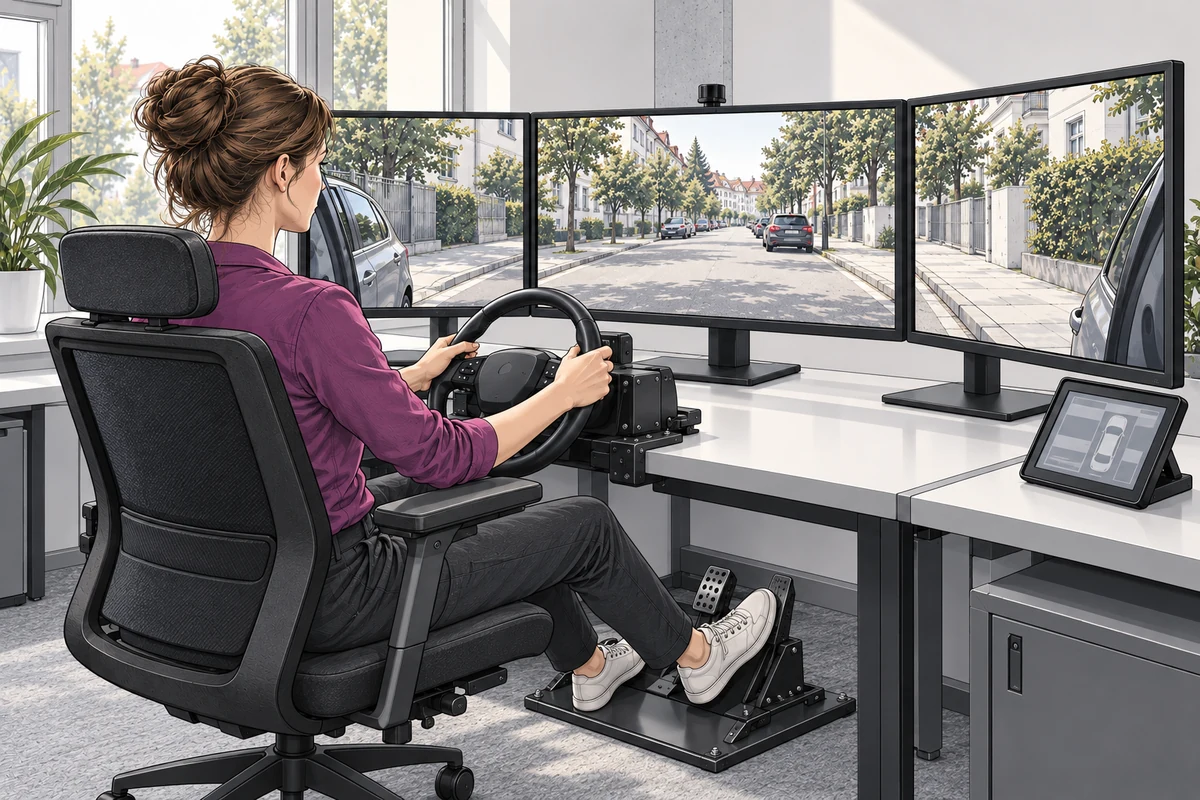
Remote assistanceThe assistant recommends going around a cone. The ADS assesses and performs the manoeuvre.Direct remote drivingThe driver outside the vehicle controls its direction and speed using a steering wheel and pedals.
The illustrations were created using ChatGPT (OpenAI), based on the author’s instructions and feedback.
Legal status: Practical description of a testing role
The person inside the vehicle envisaged by the testing project for supervision and intervention. In this glossary, this is a practical description, not a common statutory definition for both countries.
What tasks does the role involve?
The Slovak testing branch requires identification of the driver’s and permit holder’s duties. In the German automated-function branch, § 1i requires continuous supervision by a reliable driver.
A job title alone does not establish the required qualifications, scope of intervention or fulfilment of permit conditions.
Legal status: Legislation in force within the stated scope
A person acting as driver. Slovak § 49 envisages the driver holding the permit and presenting it for inspection. German § 1i expressly assigns continuous supervision to the driver for automated functions.
What tasks does the role involve?
In Slovakia, the permit holder gives the permit to the driver. In Germany, this testing branch requires the driver to be reliable in relation to the technical development of road vehicles.
This entry does not exhaust detailed driving licence requirements or all road traffic rules. The driver role cannot simply be transferred to technical supervision of an autonomous function.
Legal status: Legislation in force within the stated scope
The person entitled to apply for permission. For the Slovak branch covering an unapproved automated vehicle, this is the manufacturer or its representative for vehicles it develops or produces. German § 1i identifies the Halter as applicant.
What tasks does the role involve?
The Slovak applicant ensures technical, staffing and organisational safety prerequisites and submits safety evidence. The German application is made to the KBA.
A research team, vehicle owner or project client is not automatically an eligible applicant. The relevant statutory category must first be checked.
Legal status: Legislation in force within the stated scope
The addressee of duties associated with permitted testing under § 49(8) of Act No. 106/2018 Coll.
What tasks does the role involve?
Ensures the testing purpose, safety, provision of the permit to the driver, insurance where required and relevant registration documents. Notifies changes in conditions and provides specified data under the permit.
This role does not simply mean the person behind the wheel. Nor is it automatically a translation of the German Halter; the Slovak term refers to holding a specific permit.
Legal status: Text in force as of 7 September 2026
The Act includes this person in the definition of a driver. Supervision therefore does not merely mean observing operation without the ability to intervene.
What tasks does the role involve?
Monitors traffic and takes control safely and in good time at the system’s request or, where circumstances require, without a request, including remotely.
This is not an automatic equivalent of German technical supervision.
Legal status: Text in force as of 7 September 2026
The recipient of permission to operate an automated delivery vehicle. The vehicle operator applies for permission.
What tasks does the role involve?
Ensures safety, insurance and vehicle marking, complies with permit conditions and notification duties. Keeps records of the driver, vehicle and supervision time.
The permit holder need not be the person currently performing supervision.
Legal status: Promulgated Act No. 248/2026 Coll. It enters into force on 1 December 2026 and is not yet in force.
A person supervising a fully automated vehicle without driving it directly. This role is defined in Act No. 248/2026 Coll., which enters into force on 1 December 2026.
What tasks does the role involve?
Ensures timely safety measures and intervenes in driving where necessary. Oversight is exercised from a control centre in Slovakia. After taking over driving, the operator may drive only one vehicle and must not simultaneously supervise another.
Distinguish this role from the supervising person under the existing Act and from a remote intervention operator under EU law.
Legal status: Promulgated Act No. 248/2026 Coll. It enters into force on 1 December 2026 and is not yet in force.
The holder of the licence under new section 49a of Act No. 106/2018 Coll., as amended by Act No. 248/2026 Coll. with effect from 1 December 2026.
What tasks does the role involve?
Ensures operating safety, technical oversight, insurance, operating documentation, event reporting and records. Transport services also require operation approval under section 49b.
The licence holder and oversight operator have distinct duties. Licensing does not replace other authorisations required for a particular service.
Legal status: Legislation in force within the stated scope
A German legal term, rendered in our overviews as vehicle keeper. This entry explains the duties in the provisions examined, not a complete definition or identification of a particular person.
What tasks does the role involve?
For testing under § 1i, applies for a KBA permit. For autonomous operation under § 1f(1), ensures safety, environmental compatibility, maintenance and performance of technical supervision tasks.
The translation “keeper” does not establish identity with the driver, owner or Slovak testing permit holder. Identifying the Halter and assessing compensation require separate legal analysis.
Legal status: Legislation in force within the stated scope
Under § 1d(3), a natural person capable of deactivating an autonomous vehicle and authorising manoeuvres within the statutory regime.
What tasks does the role involve?
During autonomous operation, assesses an alternative manoeuvre, authorises it if conditions are met, deactivates the function at the system’s request and responds to its state. For autonomous-function testing, § 1i additionally requires continuous supervision and the person’s on-site presence.
Authorising a manoeuvre does not itself mean executing it directly with a steering wheel or pedals. Ordinary autonomous operation duties and testing conditions must be read separately; no Slovak equivalent is determined here.
Legal status: Temporary regime in force; expires on 30 November 2030
A natural person outside the vehicle who directly drives it using technical remote driving equipment.
What tasks does the role involve?
While driving remotely, must not simultaneously drive another vehicle; observes driving and rest periods and informs the Halter of statutory changes in fitness to drive.
Direct driving differs from authorisation of manoeuvres by a technical supervisor.
Statutory role framework: sections 6, 12–13, 46–48 and 82. Adoption of the Act alone does not launch all regimes; implementation status is explained by the official sources below.
DfT — roles in the automated passenger service permit system
Official non-statutory guidance retrieved on 7 September 2026. Sections Automated Vehicles Act 2024 and How will APS permit-holders fit into this scheme? Full framework implementation is planned for the second half of 2027.
Regulation 2: brings Part 5 into force from 15 May 2026, except sections 84 and 89(8)(b), (10). Review of the saved official text dated 7 September 2026.
Amendment adopted by Parliament on 16 September 2026 and promulgated as Act No. 248/2026 Coll. It enters into force on 1 December 2026 and is not yet in force.
When extending the selection of roles, we used NewlyPossible — Automated Driving Roles as a starting point. ROAT’s explanations draw on the cited legislation and official guidance.